
Bonneville Projected and Actual Release
A projected date forecasts a future event. An actual record documents an event that occurred. Pretrial detention turns on the case, bond, holds, and court orders, so it usually has no sentence-based date. A sentenced state case may expose several calculation points.
A transfer to IDOC, ICE, another jail, or a hospital is not community release. Follow the receiving agency.
Find a Bonneville County Release Date
Use the IDOC Resident/Client Search for state custody or supervision. Use jail and court records for a county case.
- Search IDOC by name or IDOC number.
- Match age, number, sentencing county, case, and offense.
- Read PED, hearing, Released to Supervision, and Sentence Satisfaction fields literally.
- For county custody, ask for release details and read the filed court order.
- Request the current calculation when dates conflict.
The Bonneville County release verification path explains how the sources fit together.
Idaho Dates for Bonneville Sentences
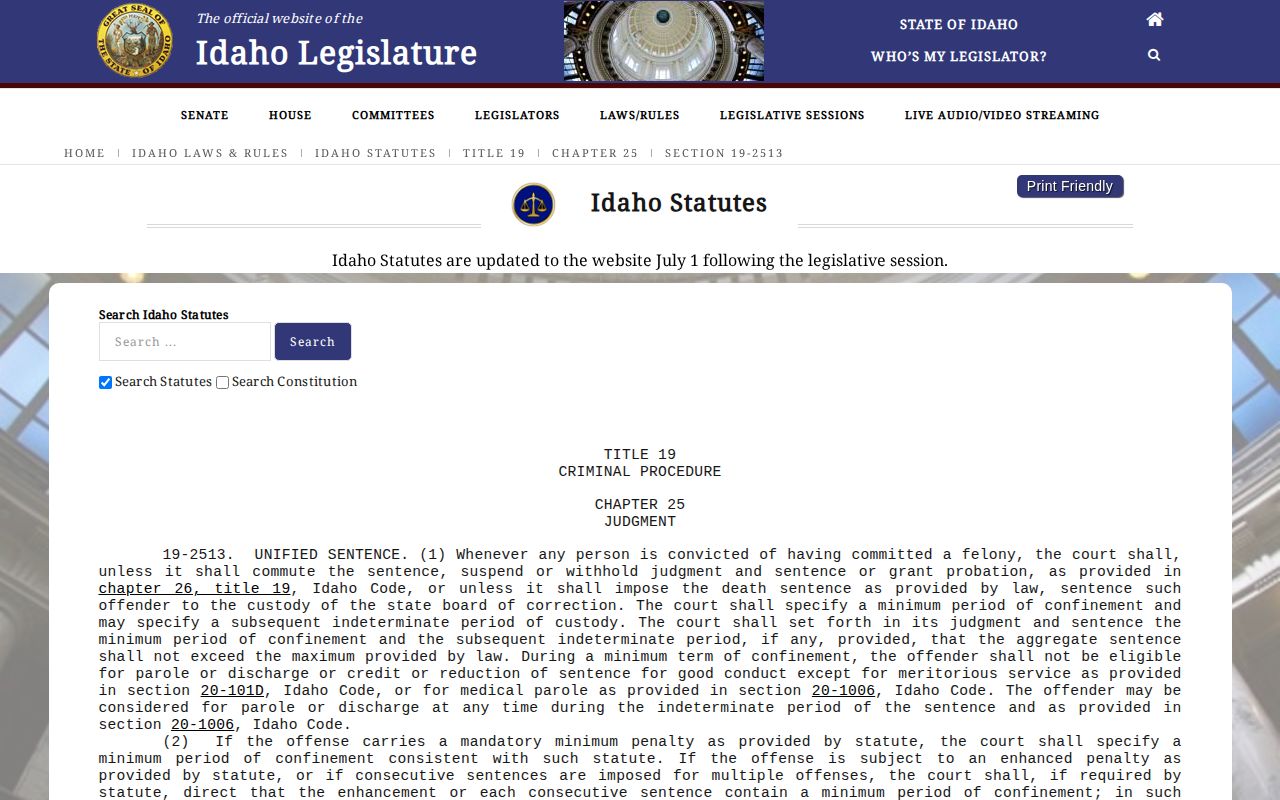
Idaho is not an “85% state” under a generic formula. Idaho Code §19-2513 creates a unified sentence. The court states a fixed term and any later indeterminate term. The fixed part must be served, with lawful custody credit, before parole eligibility. Parole later is discretionary.
IDOC Sentencing Records reviews judgments, applies county-jail and retained-jurisdiction credit, processes parole forfeiture, and updates calculations. It cannot rewrite a court sentence.
The official source below documents the unified-sentence rule used for Bonneville County release dates. The live statute controls.
Why Bonneville Release Dates Change
A public date can move after new legal or administrative information. Daily updates can also trail a fast event.
| Factor | Effect |
|---|---|
| Corrected judgment or credit | Recalculates eligibility or full term |
| Concurrent or consecutive terms | Changes how terms combine |
| Commission denial | Moves or blocks parole |
| Programs or parole plan | Delays a tentative date |
| Detainer | May cause transfer |
| Absconding or forfeiture | Can extend the term |
Ask for the latest calculation before relying on an old capture.
Confirm Bonneville County Release Dates
VINE may report a custody change, but it is not a certified calculation. Verify an alert with the jail or IDOC. For state records, request PED, any Commission TPD, Sentence Satisfaction, Released to Supervision, and final discharge as separate fields.
Include name, birth date or IDOC number, sentencing county, and case number. This prevents eligibility from being reported as release.
Three Idaho Release Date Concepts
PED is the first point when parole may be considered after the fixed term. A Commission TPD remains conditional on eligibility, programs, an approved plan, and paperwork. Sentence Satisfaction is the full-term calculation.
Released to Supervision records a past event. If a date has passed, check later IDOC and VINE status before assuming it occurred.
Bonneville Sentence Calculation Records
IDOC’s detail page is an index, not the full calculation sheet. Sentencing Records works from judgments, amendments, custody credits, retained-jurisdiction records, and parole actions. Multiple cases may run together or one after another. Enhancements can add another layer. These facts explain why an old court paper can differ from the current state calculation.
A focused request should name each date wanted. Ask for current PED, Sentence Satisfaction, any Commission TPD, any Released to Supervision date, and final discharge if it exists. Give the IDOC number and Bonneville County case number. A generic request for “release date” can mix eligibility, planning, and history.
For someone held only at Bonneville County Jail, begin with the court and jail records unit. A bond order can authorize release without showing exact processing time. A jail record can show an exit while the case stays open. If another hold exists, the expected county release can become a transfer.
Bonneville Jail Versus IDOC Dates
The correct lookup depends on legal custody. A pretrial Bonneville County Jail detainee does not have an IDOC sentence-based projected date merely because the person is jailed. Release may turn on bond, a filed court order, dismissal, another hold, or transfer. The court record explains authority, while the jail booking-and-release record supplies the actual processing time and disposition.
A person committed to IDOC follows a different framework. Resident/Client Search can show custody status, offense, sentencing county, case, Parole Eligibility Date, next hearing, Released to Supervision, and Sentence Satisfaction. Not every record shows every field. IDOC also warns that rapidly changing information may not show the newest status, location, or scheduled termination date.
Location does not decide the system. A person can be physically held in Bonneville County under another authority, and a person at Idaho Falls Community Reentry Center remains in IDOC custody. Identify who controls the sentence or hold before reading any date.
Bonneville Unified Sentence Calculations
Idaho Code §19-2513 requires the court to state a unified sentence with a fixed, or determinate, portion and any later indeterminate portion. The fixed term is the minimum period of confinement. Parole can be considered only in the indeterminate portion and remains discretionary. A sentence made entirely of a fixed term has no indeterminate parole window.
There is no supported statewide rule that a modern Idaho sentence is served at 85 percent. That shortcut belongs to other frameworks and would distort a Bonneville County date. Historical Idaho good-time law applied to offenses before July 1, 1986, not as a current formula for modern unified sentences. The actual judgment and current IDOC calculation control.
Offense-specific mandatory minimums and enhancements can affect the judgment. County-jail credit and retained-jurisdiction credit may also change the calculation. IDOC Sentencing Records applies those items but cannot rewrite a judge’s sentence. A disputed judgment or credit entry must be addressed through the proper court process.
Bonneville Tentative Parole Dates
The Idaho Commission of Pardons and Parole may issue a tentative parole date after a hearing. The public decision table can identify the hearing date, IDOC number, decision, next hearing, TPD, comments, and denial reasons. A grant is a conditional administrative decision, not proof of a physical release.
The Commission requires the date to align with parole eligibility. Required programs must be completed, a proposed parole plan must be investigated and approved, and paperwork must be finished. A detainer may alter the destination even when release from IDOC custody occurs. A denial or continuance can move the next opportunity, while a pass to full term points back to Sentence Satisfaction.
After the tentative date, check IDOC and VINE for a reported status change. “Released to Supervision” records a completed placement on probation or parole. It remains distinct from final discharge. If IDOC still says “In custody,” treat the older tentative date as uncompleted until the agency explains the current status.
Bonneville Date Changes Explained
A correction to the judgment or custody credit can alter eligibility and full term. Concurrent sentences run together in a manner defined by the judgment, while consecutive sentences run in sequence. Multiple cases and enhancements can make a single public date difficult to interpret without the calculation sheet.
Commission actions create another set of changes. Parole may be denied, continued, or granted with conditions. Programming, institutional conduct, and parole-plan investigation can affect whether a tentative date remains available. Administrative processing can also continue after a person reaches an expected date.
Post-release conduct matters too. A parole violation, detainer, or return to custody changes the record. Under Idaho Code §20-1007, a Commission finding of absconding can add time between the Commission warrant and arrest to the full-term date. Preserve older results, but use the newest official calculation for the current answer.
Build Bonneville Release Date Proof
Use a sequence rather than one screen. First save the IDOC result and its data date. Record the top status and every displayed date. Next review the Commission action for a grant, denial, continuance, next hearing, or tentative date. Then check later IDOC or VINE data for the actual custody change.
When precision matters, ask IDOC Sentencing Records for the latest calculation and separate each category in writing. Request PED, TPD, Sentence Satisfaction, Released to Supervision, and discharge. Include the full name, birth date, IDOC number, Bonneville sentencing county, and case number. This reduces the chance of receiving only a general public-search printout.
A final discharge document answers a different question from prison release. The Commission’s Gold Seal is routed through the last supervising district after parole completion and can take up to a month. Pair that document with an IDOC “Discharged” result when the end of state jurisdiction, rather than the release from confinement, is the fact being verified.
Bonneville Holds and Release Destinations
A projected date can be reached without a return to the community. An ICE detainer, federal authority, another county warrant, or other lawful hold may cause transfer. The releasing agency’s record should identify the destination or receiving authority when available. Follow the person into that system rather than reporting the roster disappearance as freedom.
For a federal sentence, use the BOP locator and read a past release date as no longer in BOP custody, not proof against supervision or another hold. A federal pretrial detainee under U.S. Marshals authority requires the federal docket and agency records route. ICE uses its own locator, with limited visibility for some recently released people.
For a Bonneville jail case, ask the direct question: was the person released to the community or transferred, at what effective time, and to which agency? That wording separates the door time from the case order and produces a more reliable date history.
When a Bonneville Date Passes
A date in the past is not enough by itself. If a PED has passed, it only means the eligibility point is behind the person. Parole may still have been denied or continued. If a TPD has passed, programming, plan approval, a detainer, or paperwork may have prevented the planned event. Sentence Satisfaction can also require a newer calculation when judgments or credits changed.
Check the IDOC data timestamp and current top-level status. “In custody” controls over an older tentative date until the agency updates or explains the conflict. “In community” shows release to active supervision, while “Discharged” points to the end of IDOC jurisdiction. A VINE movement notice can help date the event but does not replace the calculation or discharge document.
If no public source resolves the conflict, send a narrow records request and attach the older date. Ask what happened to that date, whether it was recalculated or voided, and which later event now controls. This creates a clear Bonneville County timeline without turning an estimate into a claim of release.
Public Record Search
Sponsored Results